
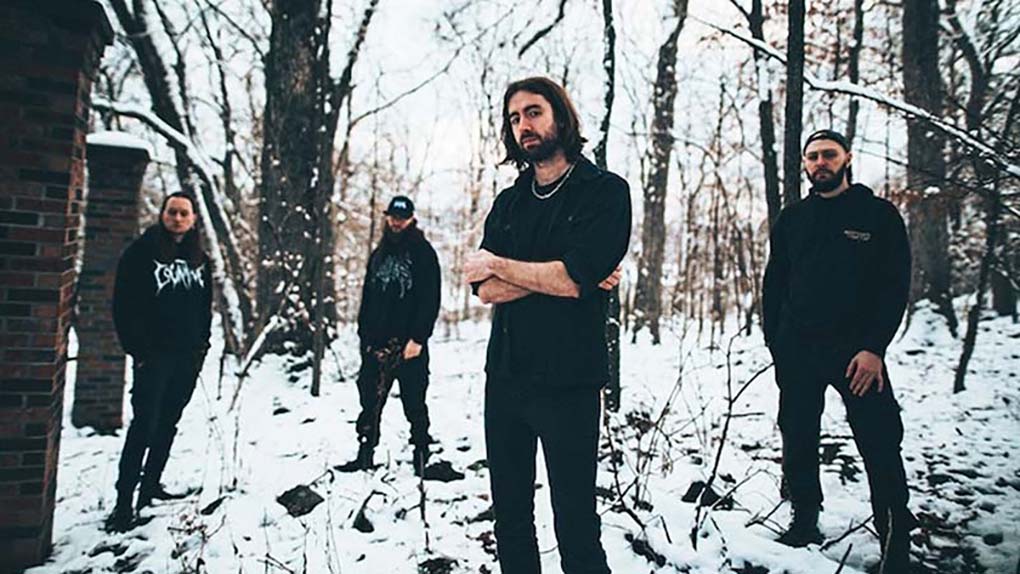
Shred Fest is nearly upon us, and this year’s edition will see the combined co-headlining of Germany’s technical death metal masters Obscura, with American progressive death metal band Fallujah. Both bands will be providing performances littered with sure to be classics from their most recent Nuclear Blast albums, A Sonication, and Xenotaph, respectively. Joining them on their travels are local bands, Ashen and Anoxia. The show will offer a variety of extreme metal sub-genres, but all involving dedicated musicianship. We caught up with Fallujah front man Kyle Schaefer on the upcoming tour which see them eagerly returning to our shores.
Most recent release: Xenotaph
Label: Nuclear Blast.
Tour Link: https://www.shredfest.net/
You are coming back down to Australia pretty soon.
Yeah, that’s right, we’re looking forward to it. I’ve been there once before personally and the band came there once years ago too before I joined as well, so it’ll be the third time for Fallujah, but only the second time for me. So, you know, the first time is all brand new, of course, but I have a feeling we’ll still see a lot of new places and a lot of new stuff this time as well.
You’ve got Obscura with you, have you played with them before?
Kind of, yes. So, that’s another one that I’ve been in Fallujah for about five years now, something like that. Fallujah toured with them once before my time for what year, but the year of tour together back in the day. We played on a 70000 Tons of Metal cruise together a few years ago, and we have another tour with Obscura before the Australian run. We’re actually going to Japan with them. So, yeah, we’ll do the Japan tour with them, split up for a little while and then kind of reunite in Australia.
There’s been a fair few personnel changes over the years, which is not a criticism, but I wonder what kind of dynamic that creates. It comes across as a bit of a project in a way for Scott [Carstairs – founding band leader].
Yeah, it’s interesting. I mean, you’re right. Our guitarist, Scott, is the only founding member we have left. But he’s also always been the guy that writes the vast majority of the music and all that. He’s kind of the Fallujah guy. There’s been shakeups over the years, with the last big lineup change moment after COVID. I kind of joined, in 2021 behind the scenes, kind of on the tail end of that. It’s one of those things where people kind of leave for various reasons. There were so many shakeups around that time for people’s jobs, their living situations and their family situations. A lot of bands saw a lot of changes coming out of COVID. So, this new era of the band in terms of lineup, but now we’ve got something nice and stable going again, which is nice. It feels like the new era of the band, but for a lot of bands that are around as long as Fallujah has, which is close to 20 years, or well over 15 years, at a certain point, in this genre, it’s hard for a people to do it forever. If you want the band to keep going, you kind of end up needing a core of people that keep the project moving and then hopefully you get people to stick around.
I suppose with Xeontaph being the core of the setlist it doesn’t really matter too much unless you’ve got a whole lot of classics that you have to play.
Right, right, which we do, yeah, we definitely try to mix in a lot of the old stuff as well, and, we’re happy to do that. It’s kind of funny that, you know, Scott being the founding member and the guy that wrote a lot of these old songs, you would think that he would be the one leaning on that material more, but it’s actually some of the newer guys that end up doing that. We did a ten-year anniversary tour for our album The Flesh Prevails, in the States and it was actually myself and our newer guitarist, Sam [Mooradian – rhythm guitar], who joined about the same time as I did, pushing for that. We’re not even on the song, we didn’t even write them, but we’re like, ‘Dude, we got to do it, the fans love this album, it’s ten years, how cool is that?’ We got to do an anniversary tour and eventually Scott said, ‘yeah, sure, we can do that.’ That’s pretty amazing.
How did you find working and recording progressive death metal in Tennessee? Most people don’t think of Tennessee as being a place for metal.
Yeah, obviously, Nashville and Tennessee in general has a reputation for country music, but it’s actually pretty diverse. The same environmental factors that make it a good place to play country music, kind of make it a good place to play all genres of music. It’s an affordable place to live, it’s central and there’s a lot of people here, it’s not like you’re out in the middle of nowhere. There’s a tonne of recording studios, and venues: everything about it is built around music in general. If you need a sound guy, if you need whatever, there’s so many people here, and they just do music in general. The metal scene is growing as well. We moved from various parts of the country, but mostly California, and we moved to Nashville about two years ago. We weren’t the first metal band to do that, and certainly it just makes sense to live here for a lot of reasons. We’ve got a nice little local scene, a nice group of touring metal musicians that are hanging up together here.
An album like Xenotaph has got so much going on that presumably the rehearsals involve continual playing to get all the changes down pat.
Yeah, this probably started because of the distance between each member, but now, even when we are mostly in the same place, we actually don’t rehearse together that much. The only time that we’ll jam songs together is when we have to book two or three days of rehearsals together, beating things into shape for a tour. Usually it’s a type of thing where if everybody does the work on their own time, then we can get in the room together, jam, and it’s honestly mostly to make sure that we have the songs down, that the gear works and that everything is fitting how it’s supposed to be, making sure that the backing tracks and the click tracks are intact. It is rehearsing separately and then everybody shows up knowing the material and the theory is that it should all fit together, and that’s usually how it goes.
How do you stay in time when you’ve got insanely fast blast beats going on?
Yeah, we use in-ear monitoring systems which are essential for this genre of music. As you said, even with the monitors and the click tracks in our ears, I still hear plenty of the live drums in the room. There are certain cues I rely on from that, and you can hear the obvious hits and stuff, but yeah, it’s staying on during extended blast beat sections. That can be a nightmare, if you’re just relying on the venue sound system: maybe it’s great, maybe it’s not; depends on where you’re playing. So, it is critical to have a click track in your ears. I definitely rely on that nowadays, but maybe we could get through the songs without that, but it certainly makes everything much easier.
The amount of time changes certainly complicates matters. Did you find that engineers or producers at the time had any say?
That was all us, we basically produced the album on our own for the most part because this time we actually did most of the recording at home. For the album we tracked the drums in a studio, because you cannot really get a professional drum sound in your bedroom, the way you can with guitar tracks, or even with a basic vocal booth. So, we recorded the drums in a studio but everything else was tracked at home. By the time we got Dave Otero involved, who did the mixing for the album, pretty much everything was set. He had some input on some things here and there, but it was more with one or two parts where he’d say, ‘I don’t know if this layer needs to be here,’ or, ‘maybe we can take this out or swap it out for something,’ but the structures and tempo changes were totally up to us and we like being in charge of all that.
How have you found looking after your voice, given you perform both harsh and clean vocals. How do you maintain your voice?
Yeah, it’s funny because I teach vocal lessons and I always tell people that it’s all about just knowing your own voice, knowing your own body, kind of knowing from experience what works for you. I find that the only thing that really seems to make significant impact on my voice as far as care, and regimen, is making sure I’m drinking enough water a couple of hours before your set so that your body is properly hydrated, and your cells have time to absorb the water. I find that makes a difference but beyond that, I don’t really do anything for warm-ups, and am not really that careful with my voice, to be honest. I do merch for us too, so I’m typically kind of shouting over the other bands at the merch table all day and then go on stage and do the set. In the world of screaming, like, there’s so many different ways to approach the techniques that work for me but totally do not work for somebody else, just based on how they scream. I feel like I’m in the middle of the spectrum in terms of my volume and the intensity of my technique. Somebody that sounds a certain way and requires a lot more exertion might have to do more to take care of their voice or vice versa, but for me, my warm-up is just talking throughout the day and I specifically don’t warm-up much because, I find that sometimes taking time to warm-up just cuts into my stamina for the day. If my voice is a little bit tired from doing shows every night, I don’t want to waste that energy, so I save it for the stage.
Some death metal vocals are intentionally unintelligible.
Sure, totally. I try to put some emphasis on the enunciation but there have been times where I’m in the middle of the song and my mind goes blank and I can’t think of the next line and you kind of just go, blah, blah, blah, blah,’ and then you remember the words and you jump into it. But you can’t quite get away with that as everyone’sfilming everything and you can’t have a bad night. It’s just with performing music in general: if you don’t act like you did something wrong, people tend to not notice, so just kind of roll with it and stay looking confident.
Do you prefer playing festivals or club shows?
I haven’t done too many festivals. We’re doing a Canadian festival called Loud as All Hell Open Air. But we haven’t quite gotten to do the European festival circuit during my time in the band yet, and that’s typically where a lot of the big festivals happen. I actually don’t have too much experience with it. I’ve done a lot more club shows with regular tours so it’s hard for me to say. I would like to do more of the festivals for sure, but I have much more experience doing like the regular club shows.
Given the Xenotaph album has had a good year or so to sit with you for live performance, is there a particular song that you most enjoy?
Good question. I like doing all the new songs in general for many reasons; they’re new to us, which makes it fun and exciting, but also the new material is the stuff that I’ve had the biggest input on by far. I got to write in a way that placed my strengths and makes the songs challenging so that keeps me on my toes. One that comes to mind is “Labyrinth of Stone”. I’ve been doing that one live quite a bit. It’s at the limit of my comfort zone, where it’s not so scary that I dread doing it but it has a lot of difficult parts that require me to switch from the clean vocals to the growling vocals on the same breath, and manage my ear a lot. So, it’s at a fun level where it’s challenging but not to the point where it’s terrifying. I’ve been enjoying doing that one.
What’s the latest album’s programming aspect for you in this band?
Since I joined, I’ve been doing synths, keyboards and sometimes piano because I have a background of some of that stuff. I’ve just dabbled in a lot of different music over the years, but I’ve had an ambient side project before and am able to bring some of that same experience into Fallujah. I will say for Xenotaph, I weirdly had a short amount of time to do that, because this is my second album with Fallujah but on Empyrean we kind of had more time to work on the music, based on when the recording sessions were scheduled. I finished all the vocals and I thought, ‘Okay, now it’s time to work on synths for Empyrean,’ and I felt like I had a lot of time to go song by song and play with a tonne of different tones and presets, and really take my time with it. That album has tonnes of synth layers that you can’t really even hear, but just kind of textures that are mixed in everywhere. I wanted to do that same thing for Xenotaph and did it in a way, but I had to do it in five days. It was five really intense days of grinding piano parts on the fly, then filling in layers and luckily I was able to use a lot of the same tones and presets that I used on the previous album. There’s enough keyboards and synths to make it feel spacey on Xenotaph, but in reality, it was very condensed in terms of the timeline. I usually like to sit on my ideas for a while before they’re fully committed to and finalised, but for Xenotaph it’s funny that even with how intricate the music is and how much time we spent on everything, somehow the synths ended up with a five-day deadline to do everything. So, yeah, it had to be spontaneous and commit to ideas on the spot. I’m happy with how it turned out. It was an interesting process that I would hope that on the next album, I would have a lot more time to work on that aspect. I prioritisedthe most impactful moments, you know, such as the spacey ambient sections. It’s like, ‘Okay, we’ve got to have something here. So, let’s start with that and hit all the mean big points,’ so it is mostly if there’s something really subtle during this big busy section already, it turned out. That’s good. We pulled it off well enough.
Indeed. We will see you here soon on tour.
Yeah, absolutely. Thanks for having me, and we’re all very excited to get back down under again for a shred fest.