
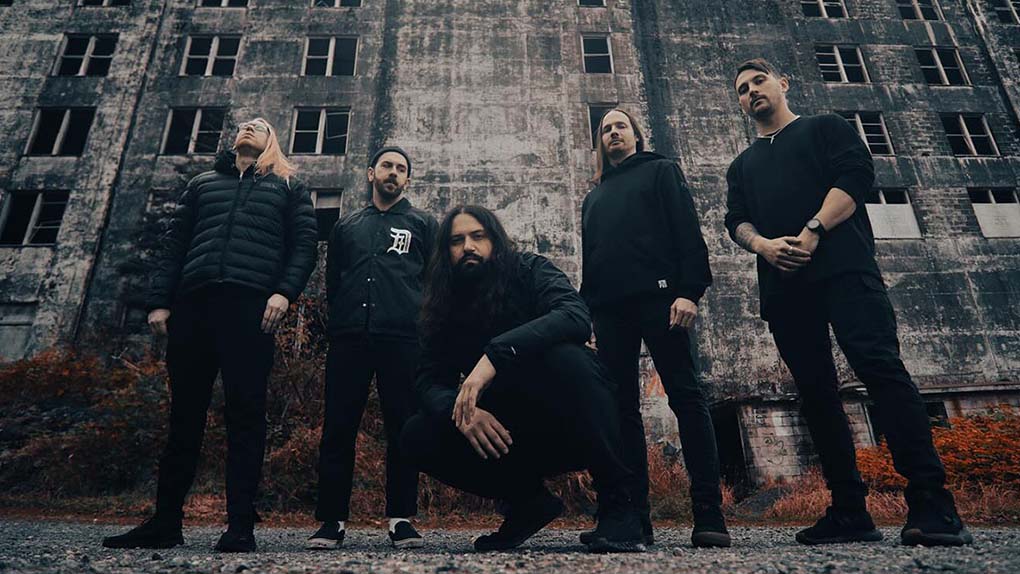
American progressive metalcore band, Born of Osiris, first rose to prominence in their scene with their debut full album, A Higher Place in 2009. But it was their technically precise 2011 release, The Discovery which aptly described their impact on progressive metalcore. Born of Osiris were last here around six years ago, so on their long-awaited return tour, their fifteenth anniversary of The Discovery will also include deathcore heavy hitters, Signs of the Swarm, along for the ride to wallop audiences into submission. We recently caught up with Born of Osiris drummer and co-founding member Cameron Losch from his home studio to discuss the coming tour, and the legacy of his impressive band.
Label: Sumerian Records
Latest Release: Through Shadows
Internet Page: https://www.facebook.com/bornofosiris
Tickets: https://thephoenix.au/born-of-osiris-2026/
Hot Metal: You’re coming back here after just narrowly escaping the pandemic when you were last here. So, what can we expect from setlist?
Cameron Losch: This is the start of The Discovery World Tour and Australia is one of the first countries to get to see that. We’re playing tonnes of songs from The Discovery, a classic album that came out in 2011. So, it came out such a long time ago. We’re celebrating the 15-year anniversary of that album. Of course we’re playing other hits from our catalogue. Even if you didn’t know anything from that album, The Discovery, you’ll be sure to hear other things you recognise that you enjoy. We’re not ignoring our last new album either; Through Shadows. We’ll get some songs from that, also from [first EP] The New Reign and, you know, Tomorrow We Die Alive, you name it. So, we’re playing a pretty good long set. If you’re a fan of Born and Osiris, you’ll recognise songs that we play for sure.
HM: The Discovery, and being the band came out of Illinois – was that a bit of a shock for the music scene around there? I mean, it’s blues central.
CL: Yeah, it certainly was, and I don’t know if Illinois has ever necessarily been known for metal, even though we do have great metal bands. But yeah, 2011 was interesting. I think, as a band, we didn’t even realise the power of what we had released at the time, and just looking back at it, I don’t think there were a lot of things that were coming out that sounded very much like it. The artwork was really cool too. I think they just go hand in hand with the visuals. Cameron Gray did the artwork and he’s actually from Australia; either from Melbourne or Brisbane, I believe. A lot of bands ended up going with Cameron Gray after he did the artwork for The Discovery. But I think it was cool. It was this whole movement of bands putting more keyboards in their music, doing more progressive song structures, and having really trippy artwork. I’m not saying we were the first to do any of these things. I mean, look at Tool. You know, we’re not the first to do that, but I think as far as metal bands kind of taking it that far, or in that direction and just doing really unpredictable song structures, I do think we did something very fresh, especially in 2011 with The Discovery.
HM: Going back a couple years before that, you had Tosin Abasi [Animals as Leaders], as a touring musician. Did he provide an impetus or influence The Discovery?
CL: Oh, yeah, for sure. I mean, spend 15 minutes in a room with that guy and you will get inspired. If he has a guitar in his hand, then you’re not going to want to leave the room because it is just insane watching what that guy can do. He’s also a really smart individual. I love Tosin so much, and he’s a little bit older than us, so I think it was cool. It was almost like having an older brother kind of teaching you things along the way when he was filling in, in the band. So, it was a lot of fun. We had a lot of laughs, and I’m really happy to see how his career has blossomed since being with with us. Yeah, we had a lot of fun, so, an Animals as Leaders tour with Born Osiris, that would be insane in Australia. Imagine that.
HM: You’ve toured with so many bands of different genres. Are there any tours that stand out over the years which was actually a fitting bill?
CL: Gosh, I’m begging Killswitch Engage to bring us out again because I just love them so much. They’re one of the first metal bands that I had ever heard. So, they have such a special place in my heart. Adam Dutkiewicz’ guitar playing with his pinch harmonics and everything about him wearing a cape on stage, he’s an absolute icon. So, there’s really too many bands to name to answer that question. But, immediately I just had to call out Killswitch Engage because we had such a fun time touring with them. I like every era of Killswitch. I don’t think people have to pick one. I think you could like the Howard era and you can like the Jesse era equally. You know, I think they’re both great.
HM: We just had Dream Theater out here and many were transfixed on Mike Portnoy’s drumming. Do you get feedback for people watching your gigs, and just watching you drum?
CL: Yeah, well, drummers especially for obvious reasons, definitely, and yeah, I can relate. I saw Dream Theater, although at the time, Mike Mangini was drumming for them, which was also really cool. I haven’t had a chance to see them with Portnoy. He’s obviously their original drummer. I’m sure that was just mind blowing when you got to see that. Yeah, Mangini – I was fixated on him too. I remember his cymbals were really high. He was hitting him so fast. I was like, how did he just like go from the snare to his cymbal that’s six feet above his head? Insane. Yeah, we got to meet them too, that day. Gosh, this was over 10 years ago. Dream Theater are obviously a huge inspiration for us. They’re insane.
HM: I gather you’ve got a tour with a slightly stripped-down kit, as you can’t bring a whole lot of little toms and things.
CL: Yeah, we do backline [renting] drums. So, thankfully with the backline stuff, it does allow me to play exactly what my normal setup is at home. What I do is I bring my own cymbals. I typically will bring my own snare drum, which is not really necessary. But I’m very particular about the snare sound. So, I do like to bring my own, and that just costs a little more money for everybody. But, you know, I’m a diva. There’s the double bass pedals and my drumsticks. So, drum wise, that’s all I bring. The things that are rental are the actual drum shells, like all the toms, the bass drum, the hardware, which is just mammoth. Imagine bringing a drum hardware case on the plane. You wouldn’t do that. It’s so heavy. I think the challenge on a tour like this though is that we’re not just doing Australia, we’re actually starting in China, then we’re doing Taipei right at the middle, hen we’re doing Japan and then the last leg is Australia. At every single one of those shows I’ll be playing a new drum set with new hardware. Generally they get it right and they provide me with adequate things. But sometimes I show up, I might say, ‘Hey, remember when you said you would have a hi-hat stand?’ That’s why I put it in the email and it’s not there. But I’m expecting that to not happen. It should be amazing. It’s always interesting when that stuff does happen.
HM: Do you plan sharing a kit with Signs of the Swarm, just to keep costs down?
CL: Yes, we are. We’re sharing the actual drums. We’ll be sharing the actual drums. I especially requested that we have our own hardware for the sake of time, because Bobby [Crow] and I have totally different drum setups. So, the changeover would take so long. I think the show wouldn’t even go on time at that point to set up everything just during the changeover. That’d be insane. But, yeah, we’re really stoked to go out with Signs of the Swarm. We’re good friends with them. They’re one of the best, if not the best, deathcore bands out right now. I think they’re just exploding. People are finally finding out about them. They’ve been around for a while. They’ve been killing it. But I think their albums just keep getting better and they’re great people, so we’re really blessed to be playing these shows with them.
HM: Did you find that when your music started out, or the genre itself, was hard for purists of metal to latch onto because you’ve got rhythm figures which kind of sound like a solo?
CL: Yeah, and the funny thing about that, there’s actually this website called Encyclopaedia Metallum and they used to have Born of Osiris in there, and this website’s been around for a long time. My band’s first release came out in 2007, The New Reign, and they had that in there. Then as we progressed, kept putting out albums slowly, I think this website decided that we weren’t metal enough anymore. They took us out. They took us out of the database. So, I don’t know if that helps answer your question a little bit but yes, I think that does go over some people’s heads. Maybe we’ve experimented too much for them where they say, ‘We’re done with you. You’re not metal anymore.’ So, yeah, my friend texted me one day to say, ‘Dude, you know, you’re not in here but all these obscure bands no one’s heard of are all in there,’ and, ‘that’s intentional that you’re not in there. They don’t mess with you.’
HM: The progressive music title is almost impossible to categorise, and that’s a good thing.
CL: It is, it is, and I think it’s cool. For my band, I do like long songs. But pertaining to my band and usually progressive stuff is known for having long songs but that’s the one place where we draw the line, especially lately. When you’ve been a band for so long, and you have eight or nine albums out, choosing a set list gets really hard. If one of the new popular songs ends up being an eight minute song, well, there goes a tenth of your set time. So, remaining progressive is awesome and formal. We plan on being more progressive than ever in the future, especially on the next album we’re working on now. But we also respect shorter to normal song lengths and I think we’re going to stay true to that. There’s nothing like a banger, two and a half minute long that kicks your ass – crazy mosh pit and then it’s just over and nothing repeated. That’s our favourite stuff, and that’s kind of the vibe we’ve been on with writing our next album now.
HM: How do you think your guitarists stay in time with you because I guess in more traditional rock they listen for the snare or kick, right?
CL: Yeah, that’s a great question. We all have in ear monitors so we can hear each other first off. But also everybody can hear a click track [metronome] and that really helps. It’s just this really annoying sound that’s just going beep boop, boop, boop, beep, boop boop boop along to the tempo of the song. So, we’re all listening to that and depending on the song, sometimes it changes like crazy. Especially our earlier material, the tempo changes are just insane. But it helps us all follow along. So yes, they do follow me. Our bass player Dan [Marinaro] has told me specifically, ‘I turn your kick drum up really loud and I mostly am just playing to your kick drum and like the click.’ So yeah, the kick drum is the biggest thing or the kick and the click, I guess, are the biggest thing people following along with live.
HM: Yeah, but particularly when it’s super-fast?
CL: That gets a little tricky then. But, yeah, it’s the click track and the drums. Now, if I lose track of the click or I stop playing, everything falls apart. But that’s the fun part about being a drummer, right?
HM: Technology has changed the way live performance goes just massively. Has it applied to drumming as well, do you think, with the advent of triggers and so on?
CL: Oh, absolutely. So, I would say the comparison to guitarists who used to play half stacks and amps. I know they still do, but a lot of the metal community has moved over to Kempers or direct in devices. You have no more amps. Things are going straight out the PA. I think that’s a beautiful thing. It’s way cleaner, and carrying cabs sucks because they’re heavy and they take up space for drums. The comparison that I would have there is using triggers. So, if you’re not familiar with what a trigger it’s a thing that attaches to usually the bass drum. So, when your beater hits the bass drum, it sends out a sound. It doesn’t mean that, like, the drums are playing for you. You still have to hit it and it make the sound. As for Born of Osiris, we use the trigger. We also use a microphone. We combine both so you have the low end from the microphone, and you get the high end for the trigger. But anyway, I think the evolution with drummers now is they’re doing the double strokes on the feet. I don’t do that very much. I’ll do it on my right foot sometimes, but I’m mostly single stroke. That’s just always been my style. But for drummers, I think they’re getting freakishly fast now because if you just think of what a snare roll is, where, you know, the roll is caused by each hand doing double strokes, well, drummers are now doing that on their feet, and more than ever, just these young drummers are all learning it and it’s jaw dropping. I think it’s just a beautiful thing, though, that music is getting more extreme, and extreme music also more accessible as well. But, yeah, to answer your question, I think triggers are kind of the equivalent to guitarists automating their guitar to do crazy noises with their Kempers, their Quad Cortexes and all the Neural DSP stuff. Drummers are doing that with their kick drums, basically.
HM: For the production side of things, are you completely doing it in house these days or do you bring someone else in?
CL: Yeah. So, for every album, it has been different. So, now I’d say we’re on about nine albums. But we like to switch it up. Sometimes we’ll go with the same producer. I know Nick Sampson, and we’ve done three albums with him, and he’s really great. We’ve worked with Joey Sturgis [mixing and mastering], Jeff Dunne [mixing], Zach Jones did our recent one, Michael Keene did our first one, Zeuss [Chris Harris – on A Higher Place], who did countless other bands, just to name a few. So, we’ve worked with a lot of different producers. But as far as the recording process, especially now, the band all records ourselves; the guitars will be recorded at home. Bass, the vocals will be the one thing, or sometimes we’ll go out and record elsewhere, but we do the demos of the vocals at home. I now record the drums at home.
HM: Everybody’s doing their own tracking?
CL: Yeah, because I do this when I’m not on tour. I record drums for bands or just for individuals. So, yeah, that’s what I do. I’m just getting my groove on down here almost every day. Recording drums for people and writing original songs for them.
HM: A lot of metal these days is still very gated and it’s become more prominent. When they have to perform live, you know, it’s a different mindset. Have you noticed that?
CL: I have, I have, especially with the guitars and just how tightly things are edited. I would say that sometimes we can be a casualty of that as well, whist that was always our style, and I think we do take pride in, for the most part, delivering that really laser focused, machine type sound live as well. On the good days, of course. But I think that’s sometimes our worst enemy. At the same time, where we like more organic stuff and I like the drums to sound like drums, not like machine programmes. We’ve had every end of the spectrum with my favourite sound, not necessarily like the favourite album, but I think maybe the favourite overall sound was we put out Angel or Alien in 2021 and there are no drum samples on that. It just sounded so organic and a little bit more unedited, like everything and it breathed a little more. I think it sounded a little more live. I like to maintain the very polished sound that we always have had. But I’d like to bring back some more natural elements. I want it to sound like a real drummer is in the room with you. I don’t want it to sound too robotic. So maybe, maybe just leaving a lot of just natural sounds and minimal edits and all that stuff. It’s kind of been my vibe lately.
HM: Have you found that being in a complex rhythm section has altered your view of more straight ahead, four on the floor, rock, that kind of stuff?
CL: Yeah, it actually. It makes me appreciate it more. It makes me appreciate playing that stuff more where if I’m just jamming out to a rock song, like, ‘imagine if this is what you had to do every night,’ you know, boom bah, boom bah. I’m like, ‘oh, my God, that’d be way more fun.’ It could be humbling if I was put in that position. I would be probably just try to overplay and everything, and then people would be like, ‘hey, our old drummer wasn’t playing double bass on all our songs.’
HM: Is there a particular song that you’re most proud of lately?
CL: Yeah. So as for the latest album, I’m most proud of “A Mind Short Circuiting”. I think we really took the elements of early Born of Osiris with the crazy tempo changes and stuff, but then we drop. Tuned it all the way to drop E – pretty low, and even in our first three albums, we had never tuned that low. I think G was probably as low as we want within our early discography. So, it was kind of the vibe of unpredictable progressive mood switches, tempo changes, heavy Meshuggah styled polyrhythms, but lower than we usually go, and with a fun outro to an electronic outro. We do it differently live, too. We play the end all as a full band, just playing along to like a rap beat. Ronnie [Canizaro] does some like Jonathan Davis, Korn style, freestyle vocals at the end. It’s really fun. I think we just like to vibe with that live. It’s a great live song and people mosh their ass off when the tempos switch. So, I love to see the room just light up.
HM: Okay, and from across your discography, is there a particular song?
CL: Since we’re doing The Discovery tour, I have to go with “Singularity”. I just love that song. I think the cool lyrics are very relevant to today. It’s kind of just about the digital age, living in a singularity. I think with AI emerging and all the crazy stuff, it’s almost like we’re in this matrix now. It’s actually real. So those lyrics were very relevant in 2011, but they’re even more relevant. Now, and it’s just a catchy song. It’s made me practice drums a lot more because it’s a tough one on drums, but I’m really enjoying getting that locked in now.
HM: How would you say the songwriting process has changed over the years?
CL: Myself and our singer Ronnie, are the last men standing because we are both original members. I started the band with Ronnie in 2003, so we’re still here but I would say the songwriting is definitely going right back to how it started. Seeing that I recorded all the instruments on The New Reign, our first album came out in 2007 but I didn’t do any vocals. That was Ronnie and Joe [Buras] at the time. But I’m obviously a multi-instrumentalist. I recorded all the instruments on A Higher Place as well. Lee [McKinney ] wrote one of those songs, so that’s when he started to write music for the band later on in our career. Then it became a collaborative effort and it’s now me and Nick Rossi, our guitarist – we are doing the bulk of the songwriting, and he is absolutely insane. He’s been writing songs with us since 2019. He came, started doing songs on The Simulation and on every album after that. You’ve heard his songs as well, and he’s just a monster. He’s wild. So, yeah, we’re kind of just taking every element of how we started. We’re beefing it up and we’re going to have a moshy good time on the next album. We want people to mosh and go crazy. It’s going to be heavy and fun.