
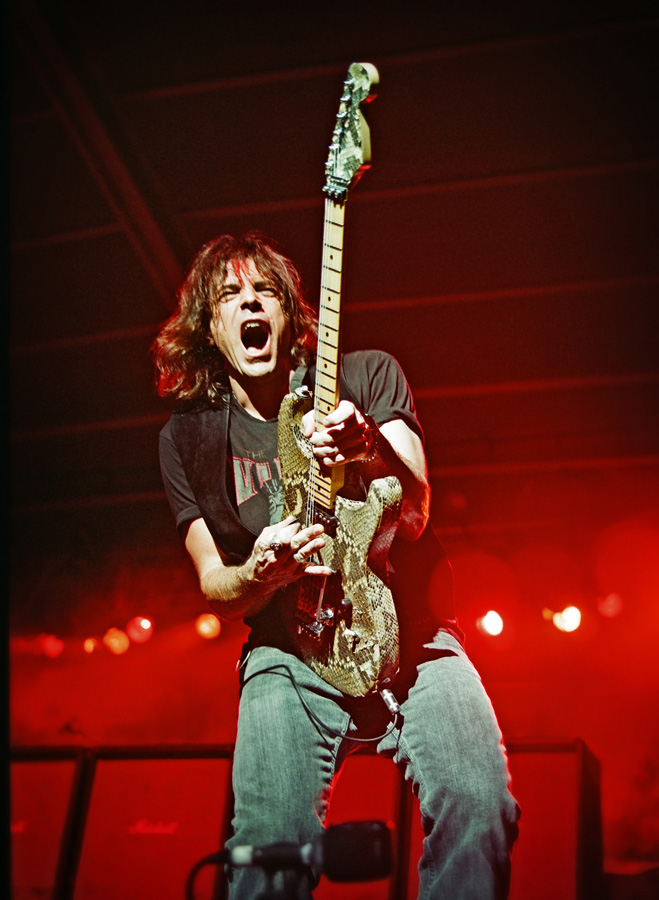
The LA metal scene of the eighties was to many image over substance in the grand scheme of things. That is unless you dug a bit deeper and checked out some of the phenomenal guitarists dedicated to their craft from the West Coast area of the States. Ratt guitarist Warren Demartini is constantly mentioned alongside the likes of George Lynch and Eddie Van Halen as major influences on numerous bands and anyone that was and remains into 80’s hard rock guitar. Warren’s infectious riffs, fast bluesy solos and glassy, smooth tone put the music of Ratt well above that of the competition. He also has a recent Charvel signature guitar released as well as signature Seymour Duncan humbuckers which is esteemed company. When Ratt recently toured Australia for the first time alongside Winger for a double bill, Australian Guitar’s Paul Southwell had a chat to Warren, the man from Ratt, all about guitars and this n’ that.
AG: What sort of guitars are you using these days?
WD: I’m using Charvels and Performance. They are all Strat types and are all based off of the Charvel Soloist guitar – they are sort of like a cross between a Strat and Tele really because the edges are not rounded on a Soloist.
AG: Why Charvels after all of these years?
WD: Well Fender bought the Charvel name and so started producing them in their Corona plant and a lot of the guys from the old San Demas days are involved and working their now. Some of them have been working there for years but it got really, really good again. So, when they approached me about doing a signature series I checked it out and got very excited about working with them.
AG: The quality sort of comes and goes with those sorts of [eighties era shred] guitars.
WD: Well, it sure did with Charvel because when I was in ‘junior high’ that was just ‘the stuff’ because for Fender guitars, the quality had gone way, way down. When it was sold to CBS records in the mid to late fifties and by the early sixties, all the wood and stuff that had been bought by the actual craftsmen was gone and now you had people that had no idea that what they were doing buying the wood and stuff. So, that’s why a lot of companies like Boogie bodies, Schecter, Charvel and Jackson got very, very big on what Fender used to be. They’ve long since turned it back around and are making very high quality stuff again.
AG: Yeah, the late eighties and the emphasis on paint work finishes were a bit wrong.
WD: Yeah and by the early nineties I think Charvel was owned by an offshore company and that was right around the time that I met Koni Sugai who owns Performance Guitar and who incidentally used to work at Fender in the 70s. It was a natural time to switch over and I started playing them [Performance] exclusively around ’87 or ’88.
AG: How vital were the amplifiers in that tone? Did they play a lot in your tone?
WD: Oh sure, the amp is the lens if you will to what you’re trying to put out there so it is extremely important. The amp and the condition of it is going to make the difference of it. For amps, I meet Michael Soldano in 1987 and I bought a couple of those and so also switched to those exclusively and pretty much just used those on everything. I have a Plexi Marshall [Tremolo 100 watt] that was out of commission for a few years. That was something that I used on ‘Invasion of Your Privacy’ and ‘Dancing Undercover’ and then it didn’t work for the whole of the ‘Reach for the Sky’ record. So I used some different things on that. Then on ‘Detonator’ the Plexi had got working again so that album was almost all of the Plexi Marshall head. Then later on when we did the 1999 Sony record that was a combinations of Soldanos and Marshalls. So, yeah, mostly Marshalls and Soldanos.
AG: When touring can you get a hold of a Plexi for the backline?
WD: No, I never see Plexis around when we’re doing stuff where we can’t bring our own gear. The most popular stuff seems to be the 800s and 900s. I’ve seen SLR in LA with a Plexi that they rent and I think you can get one in New York, but very rarely.
AG: The thing about the old ones is to get a good sound you have to crank it and then your band mates will hate you for doing it. So, what do you put in front or your amp?
WD: Yes, it’s true; it’s easy for it to be too much for a room. I do bring an overdrive just in case. I don’t use an overdrive with a Soldano and I don’t need it with a Diezel at all. Some of the Marshall 800s are a little clean for lead so I’ll bring an overdrive in case that’s all there is. The 800 is fine for rhythm but it just needs a little something for leads.
AG: Are you using any ‘midi’ gear at all?
WD: Well, the Diezel, which I’ve been using for two years, has a midi switching system that is quite nice. It is very quiet when you switch from one channel to the other and that is done by ‘midi’. Mostly I can use my own stuff but if we’re flying overseas sometimes we have to …you know it’s too expensive to bring it. But, my rig at home, I use Lexicon PCM70s and those are midi-ed up so I can switch from patch to patch and I can control the parameters with a foot pedal.
AG: With effects, it’s pretty simple?
WD: I like to keep it simple. Although now it’s kind of excessive and I’m going to simplify it more. But, I use two PCM70s with one set to chorusing and one set to delays. I use a foot pedal to bring them in and out as opposed to on and off which is more like the way that a piano pedal works.
AG: Is there any new stuff on the horizon for Ratt?
WD: Well, I hope so. The plan is to jump back into the writing room and put pen to paper which we haven’t done for almost seven years, meaning as a group being Steven [Pearcey – vocals] and I. So, it’s always an adventure and at this point we’re just optimistic and looking forward to hopefully a lot of good ideas getting down and that causing a new Ratt album.
AG: I saw a comment from Steven saying the world isn’t waiting for another Ratt album but there’d be a number of people that would disagree with that comment.
WD: You know, I disagree too. We just did sixty dates in the States and night after night that was a constant question. Everywhere we went it has come up. I don’t think that the audience went anywhere but I think that the massive changes that are going on in the music industry make it so that we need to connect to it again. That is not going to be done by buying CDs. So, in a way, Ratt has to get with the times as to how you get your music to the people that want to hear it and that will be something. Those dots need to be connected. I think, in my experience, if the work is good, it gets there. It finds a way there you know.
AG: Well, the fact that you can come to the other side of world to play to a bunch of people willing to see you is enough proof in itself.
WD: Uh huh. I’m very aware of how lucky we are in that respect and I really am enjoying the traveling and being able to visit the different places.
The late 1980s certainly produced an abundance of disposable hair metal clones ripping off Led Zep and Aerosmith riffs. But throughout, Ratt had their own sound and it is still distinctive today for reasons ranging from the ‘signature’ vocals to the quality songs with tight rhythms, good solos and a penchant for hooks that stuck in your mind long after hearing the song. The delivery and phrasing was not typical of that era as the latest ‘best of’ CD will clearly attest.
AG: Your guitar technique has a bluesiness to it that includes a style of slide, in a sense. Do you think that kind of was overlooked with the whole LA metal era? Did you get lumped in with the Warrants of the world?
WD: Oh no, I don’t think so. I think I did okay, you know (laughs) but the only way you really know is when you get around other guitarists and it seems like you’re okay. I do get a lot of support from people that say they did like the work when it came out or still like that work. It’s a lot of encouragement and that keeps you at it.
AG: Oh yeah and listening to that good tone on ‘Detonator’, which is still pretty good.
WD: Yeah, I was thinking about that the other day. We just did a ‘best of’ CD and that ranged from ’84 to ’99. I was thinking how excited one gets when you’ve done a recording and your band gets some studio time and you go in and you’re almost like, if it went well then you usually like that work at the time. But, there’s just no way to tell what you’re going to think of it in six months, a year, three years or even ten years later. The fact that some of it still sounds good today, well, we’re all very proud of that.
AG: Back in the eighties it was a ridiculous equipment overload with everyone having refrigerators of rack mounted gear. Did you laugh at that at the time?
WD: Yeah. I fell hook, line and sinker myself and I cry when I see the bills we paid (laughs). Mine wasn’t really over the top but when I really analyse what I needed and what I had, it was almost always more complicated than it needed to be for me. In the studio it is just guitar cord into the amp and into the speaker cabinet. So, if you want to add some ambience later that’s different. But my recording style was so simple and it has always been so simple. It was like, ‘why not have the live rig?’
AG: When did you start to strip down the sound? Was it around the song ‘Way Cool Jr’?
WD: Well yeah. I think that the whole production got a little less effects. ‘Way Cool Jr’ in particular was very stripped down but I think that had more to do with the nature of the song.
Warren has both signature pickups and signature guitars, which is impressive. The history of Charvel guitars luthiers and of Seymour Duncan pickups design pinpoints how much guitarists such as Mr. DeMartini spend time considering what isn’t just playable but what actually sounds good both live and when recorded. He respects the luthiers and designers behind the equipment, that excel in their craft.
AG: The pickups you’re using are EMGs or Seymour Duncans?
WD: Ah, Seymour Duncans definitely as we designed a pickup just for the signature series that Seymour put together for me. It really sounds good. I brought the original ‘crossed sword’ model [guitar] to the plant in Santa Barbara, California and Seymour made 7 or 8 pickups so we sunk them all in and listened to them. There was probably 8 or 10 people in the room and everyone really liked the one we ended up going with and it’s called the’ Rattus Tonius Maximus’ (laughs). Why not, ya know?
AG: PAF Pro and everything else are high end so if you can compete with them, great.
WD: Oh, it’s a case of ‘let’s give it a shot’. Just the experience of working with Seymour on something was just something I had never anticipated. I had been a huge fan of their stuff since high school.
AG: Did you, like George Lynch, understand the construction of guitars prior to doing a signature model?
WD: No, well to a very limited…I did okay at wood and metal shop in high school but I didn’t have the thirst, if you will, to be a master craftsman, But I had a basic understanding of it and back in those days of say late high school everybody was moving to LA because that is where the rock music scene was starting to flourish. One of the jobs you could get there was at Charvel in San Demas so I did end up knowing a couple of people that got jobs there. The thing was that, just because of the quality control, if somebody slipped on the band saw or on the drum sander and nicked the guitar to make it anything but a first class a thing, they were ordered to throw it away. So, what the guys would do is what until the executive branch would go home and they’d then turn right around and drive back to get the stuff out of the dumpsters and sell them to kids like me for fifty bucks. So, I did get a little bit of a grip on assembling guitars that way but never got to the point where I could set it up like Carl Sandoval or Koni Sagui or Yasu Yokotame. They’re like the guys that build and rebuild engines for Indy races – it’s a level of skill that’s a full time thing.
Warren has both signature pickups and signature guitars, which is impressive. The history of Charvel guitars luthiers and of Seymour Duncan pickups design pinpoints how much guitarists such as Mr. DeMartini spend time considering what isn’t just playable but what actually sounds good both live and when recorded. He respects the luthiers and designers behind the equipment, that excel in their craft.
AG: The pickups you’re using are EMGs or Seymour Duncans?
WD: Ah, Seymour Duncans definitely as we designed a pickup just for the signature series that Seymour put together for me. It really sounds good. I brought the original ‘crossed sword’ model [guitar] to the plant in Santa Barbara, California and Seymour made 7 or 8 pickups so we sunk them all in and listened to them. There was probably 8 or 10 people in the room and everyone really liked the one we ended up going with and it’s called the’ Rattus Tonius Maximus’ (laughs). Why not, ya know?
AG: PAF Pro and everything else are high end so if you can compete with them, great.
WD: Oh, it’s a case of ‘let’s give it a shot’. Just the experience of working with Seymour on something was just something I had never anticipated. I had been a huge fan of their stuff since high school.
AG: Did you, like George Lynch, understand the construction of guitars prior to doing a signature model?
WD: No, well to a very limited…I did okay at wood and metal shop in high school but I didn’t have the thirst, if you will, to be a master craftsman, But I had a basic understanding of it and back in those days of say late high school everybody was moving to LA because that is where the rock music scene was starting to flourish. One of the jobs you could get there was at Charvel in San Demas so I did end up knowing a couple of people that got jobs there. The thing was that, just because of the quality control, if somebody slipped on the band saw or on the drum sander and nicked the guitar to make it anything but a first class a thing, they were ordered to throw it away. So, what the guys would do is what until the executive branch would go home and they’d then turn right around and drive back to get the stuff out of the dumpsters and sell them to kids like me for fifty bucks. So, I did get a little bit of a grip on assembling guitars that way but never got to the point where I could set it up like Carl Sandoval or Koni Sagui or Yasu Yokotame. They’re like the guys that build and rebuild engines for Indy races – it’s a level of skill that’s a full time thing.